
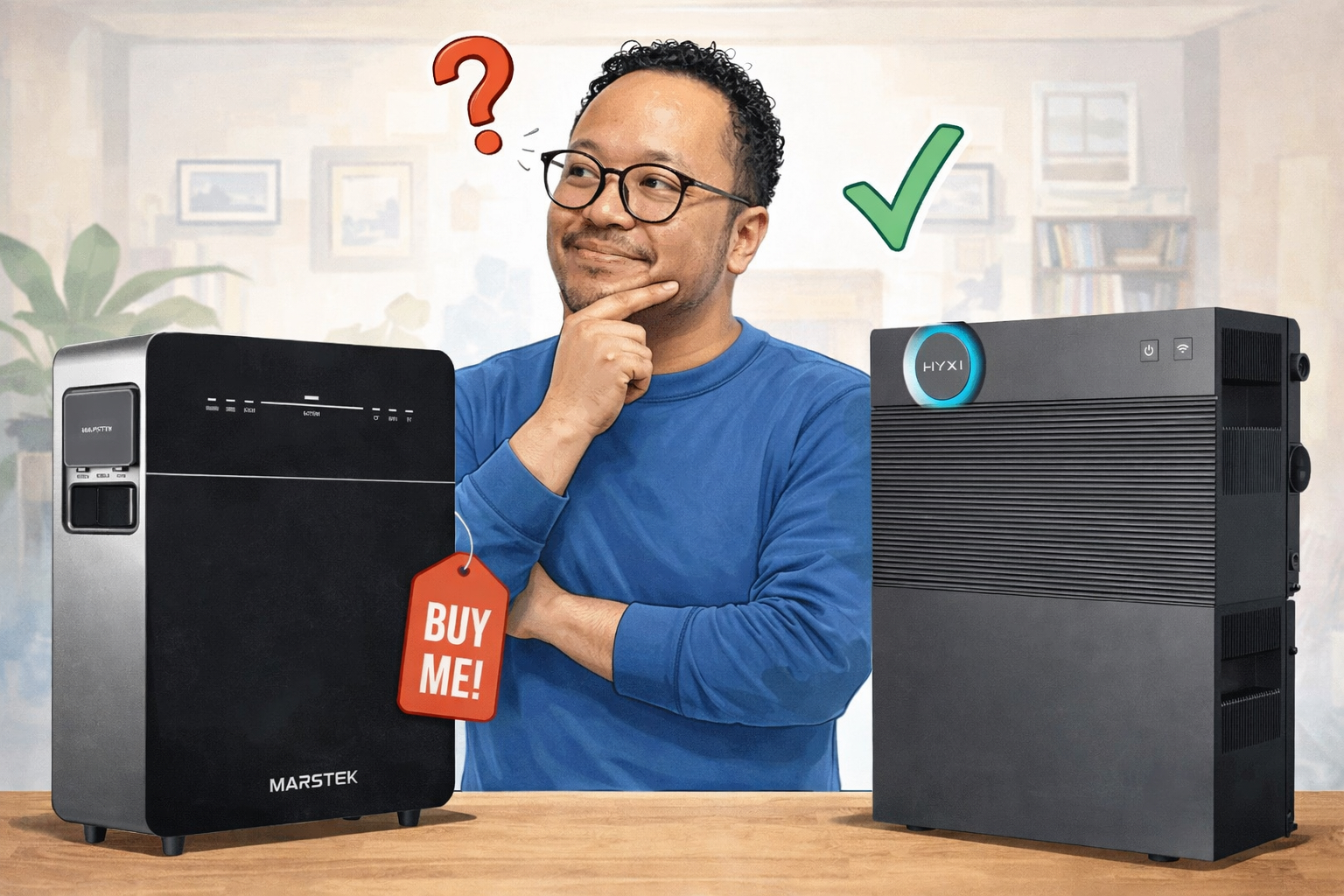
Just when I thought my research was done, the Hyxi Halo entered the picture. Here is why it deserves serious attention and how it stacks up against my original choice.
Topics
- A Quick Recap
- Who Is Hyxi?
- What Is the Hyxi Halo?
- The Feature That Got My Attention: The Auto-Extinguisher System
- Key Features and Specifications
- Pricing
- Where the Hyxi Halo Stands Out vs. the Marstek Venus 3.0
- What I Still Need to Figure Out
- Head to Head: Hyxi Halo vs. Marstek Venus E 3.0
- Still Undecided. What Do You Think?
A Quick Recap
In my previous blog post, I shared the research behind my search for a plug-in home battery. I looked at five models, compared them on P1 meter support, capacity, price per kWh, and dedicated group performance, and landed on the Marstek Venus E 3.0 as my top pick. If you have not read that post yet, it is worth starting there before diving into this update.
Read the original post here: https://www.patrickphang.nl/index.php/2026/03/25/plug-in-home-batteries-my-research-and-why-i-am-choosing-the-marstek-venus-3-0/
Shortly after publishing that post, I came across the Hyxi Halo, a relatively new plug-in home battery that has quickly caught my attention. One feature in particular made me stop and take a closer look: its built-in Auto-Extinguisher System. In a market where fire safety in home batteries is not always a top priority, this stood out immediately. I have since gone deeper into the specs and the overall proposition, and the Hyxi Halo is now a genuine contender alongside the Marstek Venus 3.0.
This post is not a final verdict. It is part of my ongoing research process. I will share what I have found so far, compare the two models in detail, and explain what I still need to figure out before making a final purchase decision.
Who Is Hyxi?
Hyxi, formally Zhejiang Hyxi Technology, is a Chinese manufacturer based in Hangzhou. The company has been active in the inverter and energy storage space for a number of years, and at the start of 2026 they reached a significant milestone: the rollout of their 500,000th inverter. They recently rebranded from HYXiPOWER to the simpler HYXI name, with a new brand proposition of “Smarter Energy for All.”
In Europe, Hyxi is growing steadily. They hosted their 2026 New Product Launch and Partners Conference in the Netherlands, gathering nearly 200 partners from across the continent. They have won the EUPD Research Top Innovation Brand Award 2025 and are in the process of opening a European service center with a training facility and customer support team. In the Netherlands, the Halo is already available through dealers including OffGridPowerStation, Multi-Solar, and SolarKopen.
That said, Hyxi is still a relatively new name in the Dutch consumer market. There are fewer user reviews available compared to established brands like Marstek or Anker, and it is not yet fully clear how warranty handling and after-sales support will play out in practice. This is something I am factoring into my decision.
What Is the Hyxi Halo?
The Hyxi Halo is a plug-in AC-coupled micro energy storage system. Like the other batteries in my original comparison, it connects to a standard 230V socket and works alongside your existing solar installation without any rewiring or inverter replacement. The base module includes the inverter, battery management system, and 3 kWh of LiFePO4 storage all in one unit.
From there, you can stack additional 3 kWh battery packs underneath the base module, up to a maximum of five packs, for a total system capacity of 18 kWh. For my household, the 6 kWh configuration (one base module plus one expansion pack) is the most practical starting point, with room to grow if my energy needs increase later.
The setup is designed to take no more than five minutes. Stacking is done without external wiring between modules; everything connects internally as you build the tower.

The Feature That Got My Attention: The Auto-Extinguisher System
Home batteries store a significant amount of energy in a relatively compact space, and fire safety is a topic that does not always get the attention it deserves in product comparisons. Most batteries rely on thermal management and BMS protections to prevent dangerous situations. The Hyxi Halo goes a step further.
The Hyxi Halo includes a fully integrated Auto-Extinguisher System. It works in three stages: early risk detection that spots potential issues before they escalate, immediate warnings that alert you via the app, and an automatic aerosol-based extinguishing system that activates if a fire risk is detected. This is a genuine hardware-level safety feature, not just a software alert.
On top of this, the Halo uses advanced flame-retardant insulation that keeps battery temperatures significantly cooler than standard aerogel insulation, and an independent thermal zone that separates the battery cells from the PCB (circuit board) to prevent cross-contamination of heat. These are not standard features in the plug-in battery market, and they address a real concern for anyone placing a battery inside or near a living space.
For me personally, this is a meaningful differentiator. Knowing that the system has a physical last line of defense in case something goes seriously wrong adds a layer of confidence that no other battery in my comparison offers at this price point.
Key Features and Specifications
Power and Capacity
The base unit delivers 800W by default on a shared socket. When connected to a dedicated group, it can be unlocked to run at 1,500W in standard configuration, and the off-grid emergency output port delivers up to 3,000W continuously. This makes it capable of powering high-demand appliances such as washing machines, microwaves, and coffee machines directly from the battery during a grid outage.
Battery Technology and Longevity
The Halo uses LiFePO4 prismatic cells, rated for 10,000 cycles with a 10-year warranty and a 15-year design life. It is worth noting an important nuance here: the 10,000-cycle figure is measured to 60% remaining capacity at end of life. Most competitors in this market measure their cycle ratings to 80% remaining capacity. When applying the same 80% standard, the Halo’s effective cycle count is likely in the range of 6,000 to 7,000 cycles, broadly comparable to the competition. This is not a red flag, but it is worth understanding before comparing headline numbers.
Weather Resistance and Operating Range
The Halo carries an IP66 rating, making it fully weatherproof and suitable for outdoor placement. It operates reliably from -20°C to +55°C, with built-in self-heating for cold weather startups. Combined with the IP66 rating, this makes it one of the more versatile options for placement in garages, utility rooms, or even garden sheds.
Noise Level
The Halo uses passive (natural) cooling and produces just 25 dB of noise during operation. For context, that is quieter than a whisper. This makes it genuinely suitable for indoor placement in living spaces, bedrooms, or apartments, which is not something all batteries in this segment can claim.
Smart Features and P1 Meter Integration
The Halo includes AI-based energy optimization that learns your usage patterns, forecasts solar generation, and responds to real-time electricity prices. It integrates with dynamic tariff providers and supports Virtual Power Plant (VPP) participation via the HYXI Smart Energy Platform.
Important note on P1 compatibility: At the time of writing, the Hyxi Halo works with its own included P1 meter and with Shelly energy meters. Support for the HomeWizard P1 meter is expected around April or May 2026 but is not yet available. There is currently no local API and no Modbus access, which means Home Assistant users who want full local control will need to wait for future firmware updates or rely on cloud-based automation. This is something I will continue to monitor before making a final decision.
Design
The Halo includes RGB lighting that indicates system status and can be customized for aesthetics. It is an unusual feature for a home battery, but it adds a modern, considered feel to what is otherwise a utility product. Dimensions of the base unit are 460 x 281 x 279 mm and the unit weighs 28 kg.
Pricing
Based on current Dutch retail pricing, the Hyxi Halo is available in the following configurations:
- 3 kWh (base module, P1 meter included): approximately €899
- 6 kWh (base module + 1 expansion pack, P1 meter included): approximately €1,448
- 9 kWh (base module + 2 expansion packs): approximately €2,100
For the 6 kWh configuration that fits my household, this works out to approximately €241 per kWh, which is competitive and slightly better than the Marstek Venus 3.0 at €254 per kWh. However, the dedicated group power output of the Halo at 1,500W is lower than the Marstek’s 2,500W, which is a meaningful practical difference in daily performance.
Where the Hyxi Halo Stands Out vs. the Marstek Venus 3.0
After going through both systems in depth, here is how I see the key differences:
| Hyxi Halo strengths | Marstek Venus 3.0 strengths |
|---|---|
| Built-in Auto-Extinguisher System, unique in this segment | 2,500W on dedicated group (1,000W more than the Halo) |
| IP66 weatherproofing, suitable for outdoor placement | 5.12 kWh in a single base unit, no expansion needed |
| 25 dB passive cooling, quieter than most competitors | Native P1 meter included and fully functional right now |
| 3,000W off-grid emergency output | Local API and broader smart home integration |
| 10,000 rated cycle life (see nuance in article above) | Established brand with strong NL support network |
| Lower price per kWh at 6 kWh configuration (~€241 vs. ~€254) | Proven track record and active user community |
| Compact stackable tower design, lighter at 28 kg | Backward compatible with V1 and V2 units |
What I Still Need to Figure Out
Before I can make a final decision between these two, there are a few open questions I want to answer:
- Real-world P1 performance of the Halo: The included P1 meter works in theory, but I want to verify how well it performs in practice with Dutch smart meters, particularly for zero-import optimization.
- Warranty and after-sales in the Netherlands: Hyxi is growing its European presence, but I want to understand more concretely how a warranty claim or support issue would be handled for a Dutch customer today.
- Dedicated group power ceiling: The 1,500W limit on a dedicated group is significantly lower than the Marstek’s 2,500W. For my usage patterns, I need to assess whether this is a practical constraint or just a number on paper.
- HomeWizard P1 support timeline: If this arrives as expected in April or May 2026, it removes one compatibility concern. I will wait to see whether it lands on schedule.
I will publish a follow-up post once I have worked through these questions. At that point I expect to have a clear final answer between the Marstek Venus 3.0 and the Hyxi Halo.
Head to Head: Hyxi Halo vs. Marstek Venus E 3.0
| Specification | Hyxi Halo | Marstek Venus E 3.0 |
|---|---|---|
| Battery Chemistry | LiFePO4 (prismatic cells) | LiFePO4 |
| Base Module Capacity | 3.014 kWh | 5.12 kWh |
| Recommended Config for ~6 kWh | Base module + 1 expansion pack (6.028 kWh) | 1 base unit (5.12 kWh) |
| Max Expandable Capacity | 18.084 kWh (base + 5 packs) | 15.36 kWh (3 units, 1-phase) |
| Power via Shared Socket (default) | 800W | 800W |
| Power via Dedicated Group | 1,500W (Premium mode) | 2,500W |
| Off-Grid Emergency Output | 3,000W (continuous) | 2,500W |
| Auto-Extinguisher System | ✔ Yes (aerosol-based, built-in) | ✘ No |
| IP Rating | IP66 | IP65 |
| Outdoor Placement | ✔ Yes (IP66) | ◑ Yes (IP65, sheltered preferred) |
| Noise Level | 25 dB (passive cooling) | Low (passive cooling, fanless) |
| Operating Temperature | -20°C to +55°C | -20°C to +60°C |
| Cycle Life (rated) | 10,000 cycles (to 60% capacity) | >6,000 cycles (to 80% capacity) |
| Cycle Life (comparable basis, ~80%) | ~6,000 to 7,000 cycles (est.) | >6,000 cycles |
| Warranty | 10 years | 10 years |
| P1 Smart Meter Support | ✔ Native (own P1 meter) + Shelly | ✔ Native (Marstek P1 CT003) |
| HomeWizard P1 Support | ◑ Expected April/May 2026 | ✔ Yes (via API) |
| P1 Meter Included | ✔ Yes (all NL bundles) | ✔ Yes (NL bundles) |
| Local API / Modbus | ✘ Not available (cloud-based) | ◑ RS-485, limited native HA |
| Home Assistant Integration | ✘ Not currently supported | ◑ Via RS-485 (limited) |
| Dynamic Tariff Integration | ✔ AI optimization, VPP, Frank Energie | ✔ AI optimization, TOU scheduling |
| Connectivity | WiFi, Bluetooth | WiFi, LAN (UTP), RS-485, Bluetooth |
| RGB Status Lighting | ✔ Yes (customizable) | ✘ No |
| Dimensions (base unit) | 460 x 281 x 279 mm | 480 x 153 x 624 mm |
| Weight (base unit) | 28 kg | ~64 kg |
| Wall Mounting | ✘ Floor-standing tower | ✔ Wall bracket included |
| Brand Maturity in NL | Growing (relatively new to consumer market) | Established (strong NL presence) |
| Approx. Price at ~6 kWh (incl. VAT) | ~€1,448 (6 kWh, P1 included) | ~€1,299 (5.12 kWh, P1 included) |
| Price per kWh (approx.) | ~€241 per kWh (at 6 kWh) | ~€254 per kWh (at 5.12 kWh) |
Prices are indicative based on Dutch market data as of March 2026. Always verify current pricing with retailers before purchasing. Cycle life figures are compared with important measurement standard differences noted in the article above.
Still Undecided. What Do You Think?
My research is ongoing and I have not made a final call yet. Both batteries have clear strengths and the decision will depend on the answers to a few remaining questions.
I would love to hear from you in the comments:
- Do you have experience with the Hyxi Halo? How has it performed in daily use?
- How important is fire safety as a factor in your battery purchase decision?
- Would you choose a higher dedicated group power output or a built-in extinguisher system if you had to pick one?
- Are you also considering the Marstek Venus 3.0 or the Hyxi Halo? What is tipping you one way or the other?
Leave a Reply